
Problem: Constructions with a two-sided straightedge.
A variation on the classic compass and straightedge constructions.
Here, the single tool is a two-edged straightedge.
We can draw parallel lines at a fixed distance, but do not have a compass.
Using only a two-sided straightedge, construct the following:
Angle Bisector
Perpendicular Bisector of a segment
Perpendicular line through a given point on a line
Line parallel to a given line through a point not on the line
Perpendicular to a given line through a point not on the line
30-60-90° Triangle
Let's give the straightedge a name: S.
Blue lines are the givens,
Black lines are drawn along the edges of S,
Red is the final result.
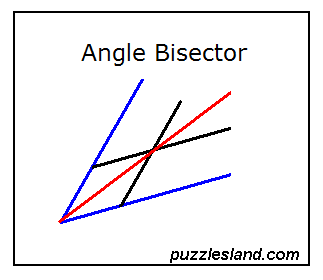
Angle bisector:
Lay S along one side of the angle
and draw a line on the opposite edge.
Then lay S along the other side of the angle
and draw a line on the opposite edge.
The two lines drawn are parallel to the edges
and at the same distance apart (the width of S).
Together with the sides of the angle, they form
a rhombus, and the diagonal of it bisects the angle.

Perp. Bisector of segment:
The segment has to be longer than the width of S.
If not, get a narrower S.
Lay S so that the each endpoint of the segment
is on one of the edges of S. Draw lines using
each edge of S.
Turn S so that each endpoint is again on one
of the edges, but the "opposite way".
Again, draw lines on each side of S.
The four lines form a rhombus, with the original
segment as one diagonal. Draw the other diagonal,
which will be the Perp. Bisector of the the original segment.
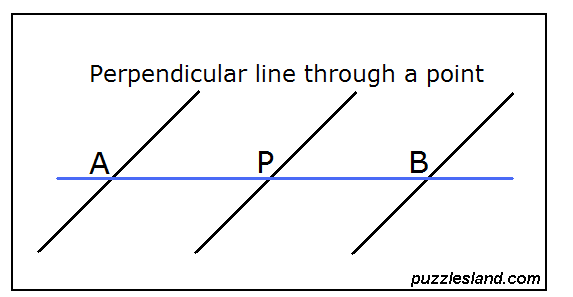
Perp. to given line through a point on the line:
Lay S crossing line at any angle with edge on given point, P.
Draw lines on both sides of S, one passing through P,
the other through A.
Slide S so other edge now passes through the given point,
and draw a parallel line on the other side of S, through B.
The two outer crossing points (A and B) are same distance from
the given point P, so you can use the previous technique
to construct the perp. bisector of the segment AB,
which will be a perpendicular, passing through P.
The following were sent to me in December, 2012, by
David S Dickerson, PhD
Assistant Professor
Mathematics Department
SUNY Cortland
PO Box 2000
Cortland, NY 13045

Parallel to a line through a point not on the line
Starting with line L and point A, lay S so that one side is tangent to A and crossing L. Draw lines using each edge of S.
Label the intersection of L and the line containing A, B.
Label the other line M.
Slide S and make so that its opposite edge is along line M
and draw a third parallel line as shown. Label this line, N.
Label the intersection of line L with line N, C.
Draw line AC. Label the point where line AC intersects line M, E.
Draw line BE. Label the point where line BE intersects line N, D.
Draw line AD.
Perpendicular to a line through a point not on the line:
Combine the previous two.

30-60-90° Triangle
Start with a perpendicular to line L through point A.
Lay S along L and draw a parallel to L at a distance of the width of S from L. Label this line M.
Slide S so that the other edge is now along M, and draw a parallel to M at a distance the width of S from M. Label this line N.
Label the intersection of the perpendicular and N, B.
Position S so that one side of S is tangent to A and the other side is tangent to B.
Draw the line along the edge of S that runs from B to L. Label the point of intersection of this new line with L, C.
Triangle ABC is a 30-60-90 triangle.
