

 Blokus Puzzler Applet
for solving Blokus puzzles or trying out game strategies.
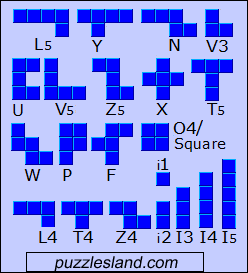 You have sets of pieces in four colors
of all polyominoes in sizes 1-5:
You have sets of pieces in four colors
of all polyominoes in sizes 1-5: monominoes through pentominoes -
21 pieces totaling 89 squares in each color:
84 pieces and 356 squares altogether.
When the same letter designates pieces of different sizes, the number of squares is appended - always for 3 and 4, and optionally for 5. i1 and i2 are often just "the 1" and "the 2".
The Game
In the competitive game, each of four players takes one color and tries to place as many of his pieces as he can while blocking the opponents'. In a two player game, each player has two opposite colors.Placement rules
Each color starts from its own corner. After the first, each piece of a given color
must touch another piece of the same
color at a corner, and must not
touch another piece of the same color at a
side.
After the first, each piece of a given color
must touch another piece of the same
color at a corner, and must not
touch another piece of the same color at a
side.
Here's what a game might look like if players were being cooperative rather than competitive:


In actual games, the highest possible score is 218-218 (436), but typically around 300 total points are scored.
What is the lowest possible total score ?

Here is a one-sided game 127-14, total 141, with the 15 point bonus bringing the total score to 156,
but to get a lower score, a more balanced approach,
and of course no bonus,
is called for, such as in this game:

with the remarkably low total of 118 (64-54),
by "darth8calculus" (in 2016), surpassing (or is it sub-passing?)
a modification by "stanley" (62-58, in 2011) of a 62-59 game
discovered by "rubik87" in early 2009.
In the normal course of play, on rare occasions there
is no place for the 2-piece, or even more rarely, the 1 piece.
Here are a couple of "games" where all the pieces are played,
but there is no spot for ANY of those pieces:

Following the Blokus placement rules:
-
The 'largest' possible game consists of playing
all the pieces of all the sets (356 squares).
Fitting all the Blokus pieces can be done on significantly smaller boards than the standard playing board of 400 squares (20x20).It can be done on 19x19 (361) or 18x20 (360) boards, which have just 5 or 4 unused squares. In 2007, a 21x17 with just ONE unused square was discovered, as was a 21x16 with NO empty space (but without the four "I" pentominoes).
In December, 2009, two more 21x17's were found. These two differ only the middle, where the yellow square and Z are switched, along with red 1, 2, and I3 pieces. This yields one symmetric and one slightly asymmetric solution. Asymmetric solutions are much more difficult to find.In 2008, enlisting computer assistance, I found 13x14, 12x15, and 10x18 solutions for two colors. (With the 13x14's fleshed out in 2014.) These have just 4 and 2 empty squares, respectively. The latter two can be duplicated to produce 15x24 (or more 18x20) solutions for four colors, also filling 360 squares.
In 2016, Evan O'Dorney asked about filling 12x14 with 2 colors, omitting the I5's. The results are HERE.
In 2011, I returned to the one-color challenge, a problem which proved too much for a simple minded computer search: there are simply too many possibilities. Here are some of the by-hand results in 150, 152, 153, 154, and 156 squares: 1-color solutions
(thanks to mike_yosuke for the most difficult 152).
For those smaller boards, general solving is very difficult: it seems that there is always a piece or two left at the end which won't fit. (I have found such a four-color solution for 19x19, after many hours of trying.)
An easier method is to use symmetry: put a mixed, complete set of pieces together (one of each kind), and replicate that configuartion as a quadrant or half of the overall solution. (More information HERE )
(Click the space below to see my best efforts. The image cycles with each click through all results, then back to blank.) 
- Here is the Most Lopsided Game Possible (218-14). Note that red and blue don't even touch.
- Here are two colors in a 4x47 (188 squares) configuration. These four sections fit together: the first and third are rotational symmetries of each other, and the other two have their own rotational symmetry. Furthermore, the two ends will fit together, so this could done on a cylinder.
- What if you are constrained to play the monominoes (single-square pieces) in the corners of the board ?
- What configurations can be created, using (2,3,4 colors) with no empty squares ?
- What is the largest of those ?
- Another puzzle, suggested by "stanley" is to cover
as many squares as possible without pieces touching
at all.
Here is a solution which covers 184 squares:
(186 is also possible, but not in such a symmetric fashion)

Here is a minimal "covering" with just 63 squares occupied:

- What other questions might be posed ?
- Solutions to a Tetrominoes Puzzle


